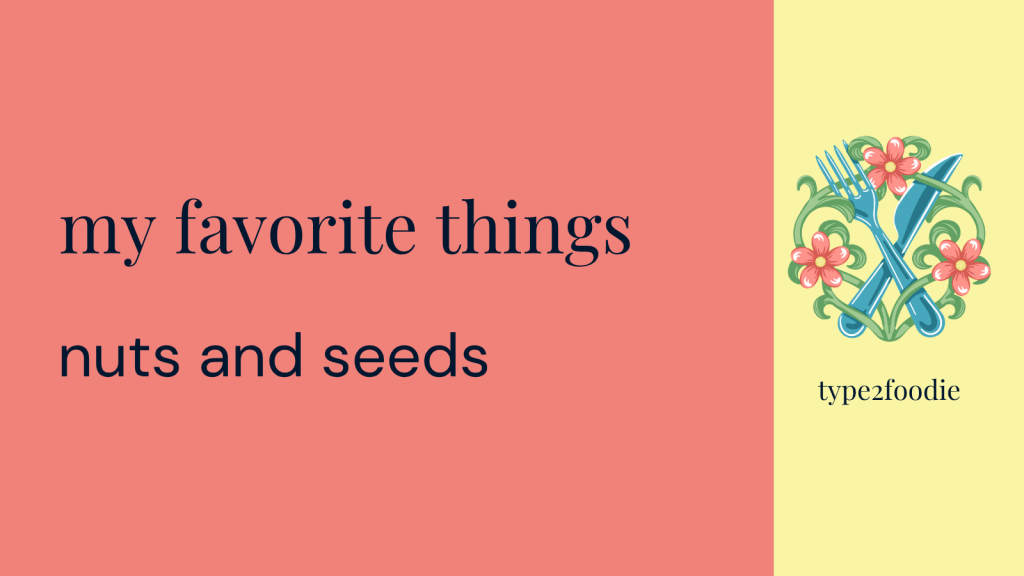
I’m back with a new addition to the my favorite things series! These posts focus on ingredients and tools that I rely on frequently to make cooking and baking more enjoyable! This month, I’m taking a look at a pantry staple—nuts and seeds.
Previously on my favorite things:
Introduction
For me, nuts and seeds are one of the staples I rely on nearly every day. Whether it’s tossing walnuts into a salad, making chia pudding, or snacking on homemade trail mix, they provide a balanced option that contains fat, fiber, and protein—aka, the diabetes trifecta.
favorite nuts
general ideas
homemade nut butter: I love peanut butter probably more than most people, but I really enjoy making homemade nut butter. If you have a good food processor or blender, it’s surprisingly easy and it’s fun to play around with different combinations of nuts and flavorings.
I like a mixture of walnuts, pecans, vanilla, and cinnamon, but cashews, hazelnuts, and pistachios are all nice as well. I store nut butter in a glass jar in the fridge, but it usually doesn’t last very long as I’ll eat it plain as a snack or use it in baking anywhere you’d use peanut butter.
trail mix: another simple homemade snack with a number of different personalized options. Again, I personally tend to like walnuts and pecans as a base, with options such as:
- dark chocolate
- unsweetened dried cherries
- sunflower seeds
roasted nuts:
walnuts
Walnuts are one of my all-time favorite options, with a wide range of uses from savory to sweet. Black walnuts are a US native and have incredible uses as dye as well as food. Walnuts are also used in cuisine around the world, including Chinese, Italian, and English recipes!
I buy the giant bags of walnuts from Costco as I’ve found that the most cost-effective for me.
savory
sweet
- walnut jam cake (made with allulose, this is a favorite blood sugar friendly cake!)
- cherry chocolate & orange trail mix (Complete Diabetes Cookbooks
pecans
Pecans are another favorite, with a sweet flavor and crunchy texture that make them a pleasure to eat. Again, I tend to buy a giant bag at Costco.
savory
- tuna salad with apples, celery, and pecans (I don’t use a full 1.5 apples)
- apple feta & pecan green salad
sweet
- orange spice coffee cake (Joy of Gluten-Free Sugar-Free Baking)
- cherry pie energy bites (Mary Ellen Phipps)
cashews
Much has been made of “cashew cream” in vegan circles, using soaked raw cashews to create a creamy paste that can be used instead of whipped cream. Because cashews have a pleasant buttery taste and a soft texture, they can be used in a variety of recipes. Personally, I like them roasted and salted for snacking, or in sweet recipes like the ones below.
savory
- chicken with cashew nuts (Terry Tan’s China)
- Citrus Ginger Cabbage with Sesame Tofu (Justine Cooks)
sweet
- no bake coconut & cashew energy bars (Easy Diabetes Cookbook, Mary Ellen Phipps)
- chocolate orange vegan mousse (Nadiya Bakes)
peanuts
Where would I be without the humble peanut? I eat peanut butter almost every day, particularly in my nightly “peanut butter snack” that consists of peanut butter, vanilla, flax or chia seeds, and some crunchy walnuts or pecans. Is it good? Who can say!
Peanuts are so versatile that it feels a bit silly to list recipes here, but here are four that make them shine.
savory
- skewered chicken with lime mint & chile salad (a change of appetite)
- peanut chutney
sweet
favorite seeds
general ideas
Granola add-in: I love adding all kinds of seeds when I make granola. Sunflower and pepitas are probably the most common in recipes, but I’ve also used sesame seeds and chia seeds and enjoyed them!
Larger seeds, like pepitas and sunflowers, are also great for adding a little crunch and flavor to savory food in places you might use croutons or breadcrumbs. I enjoy both as a salad topping!
pepitas
Pepitas are the kernel of a pumpkin seed that grows without the hard shell you might usually find in a jack o’lantern style pumpkin. They have a long history within Mexican cuisine and culture and are valued for their nutritional value and versitility. I usually buy them, roasted and salted, from Aldi and add them to trail mix, eat them solo as a snack, or use them as a crunchy topping for salad.
sesame seeds
From tahini to sesame chicken, sesame seeds have an incredible range of uses across many types of cooking. I enjoy them as a toasted topping or as a granola addition.
- toasted sesame almonds (Smitten Kitchen)
- sesame coated chicken (Terry Tan’s China)
sunflower seeds
Sunflower seeds are one of my favorite snack options, particularly as part of trail mix or granola. They have a satisfying flavor that can sometimes lean a bit bitter but adds a certain contrasting interest to sweeter nuts and seeds.
- the big green little gem salad (Smitten Kitchen Keepers)
- crunchy topping for salad
chia seeds
Lately, I’ve been having chia pudding for breakfast almost every day, mixing it together the night before. My standard recipe is 1T (9g) chia seeds, mixed with 1/4c (60g) kefir or kefir + almond milk. In the morning, I mix in a bit of peanut butter and enjoy. I, a weirdo, enjoy tapioca pudding, so the texture of chia doesn’t bother me at all. If it annoys you, however, you can always blend it.
Aside from this, I like to add chia seeds to baked goods, such as muffins, to up the fiber content a bit. I find them less noticeable in that context.
- no bake almond joy snack bites (I omit the honey)
- chia pudding with blood oranges & dark chocolate (I omit the honey and don’t make the orange syrup)
- cottage cheese breakfast bowl
Flax seeds
I primarily use flax in its ground form, as an addition to almond flour in baking. Typically, I’ll use about a 1:4 ratio of flax to almond flour to adapt standard recipes. Flax is also well known as an egg replacer, although I rarely use it this way.
These ideas are just scratching the surface of the many, many ways people with diabetes can use nuts and seeds as part of their everyday diet! Happy eating!


Leave a comment